Local Leadership, Lasting Change
We believe that sustainable change happens when the people closest to a problem lead the solution. That belief shapes everything we do – and the localisation approach we follow.
Why localisation matters
For us, localisation is not a project or a trend. It is a commitment to building more equitable partnerships and supporting locally led change. For decades, international aid too often treated communities as recipients rather than partners. We’re working to change that. Local communities know their context best – the needs, the risks, the opportunities, and what actually works. Yet funding, visibility and decision-making power have often stayed concentrated with international organisations like ours.
Localisation means shifting that balance: more decision-making power and more recognition for local actors – while Solidar Suisse contributes what we’re well placed to offer: access to international networks, technical expertise, and a bridge to Swiss and global policy discussions. Solidar Suisse has engaged with the localisation agenda since 2007, and it is anchored as a strategic priority in our 2025–2028 global strategy. We collaborate with 419 partner organisations across our programmes. In 2025, 55% of the funding covered by our reporting went to local partner organisations. These figures are one measure of our commitment to equitable partnerships – and a reminder that localisation is ongoing work.
Our partnerships, in four words
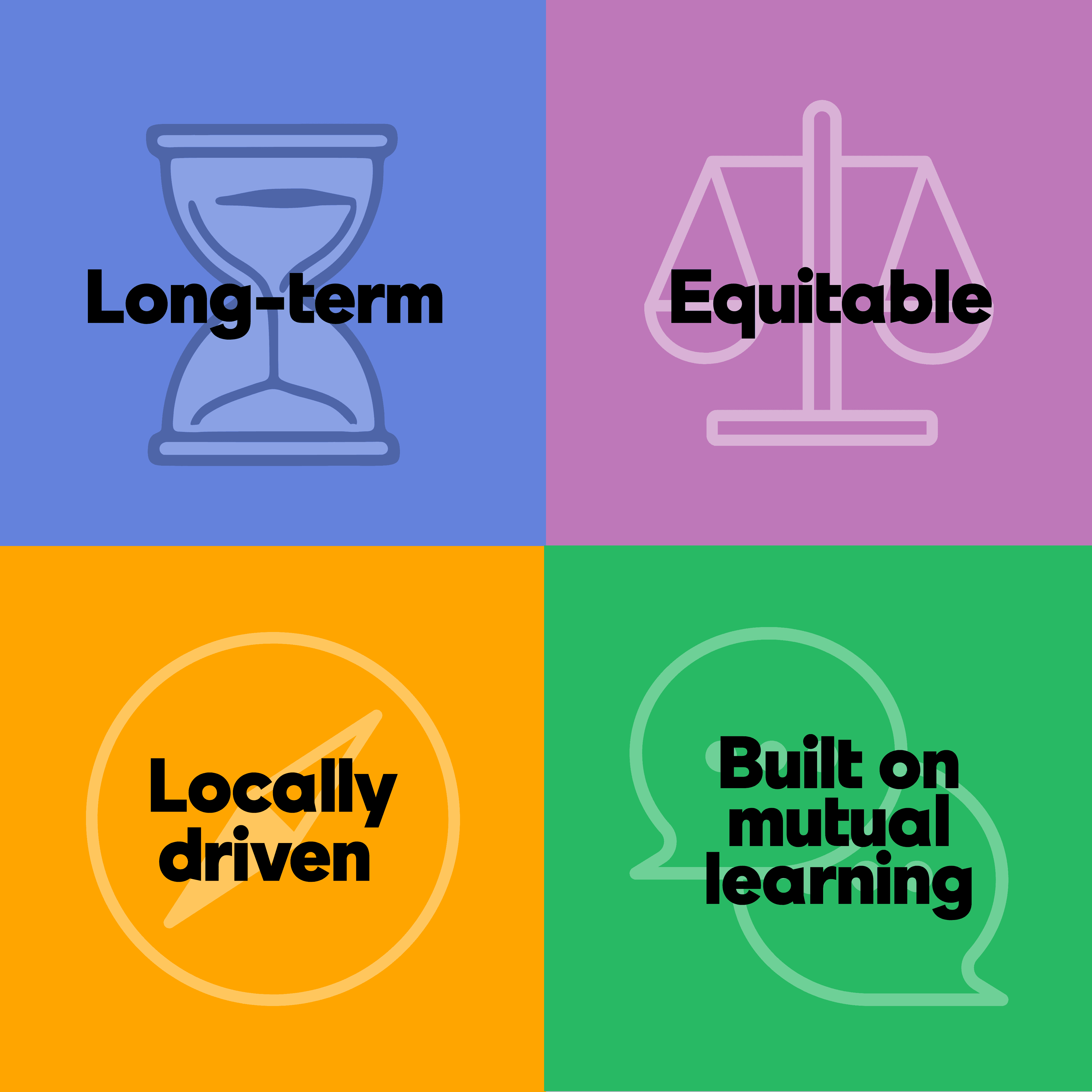
Long-term · Equitable · Locally driven · Built on mutual learning: Knowledge flows in both directions: local partners contribute contextual knowledge, social legitimacy and innovative approaches, while Solidar Suisse contributes technical expertise, international exchange and access to networks.
What this looks like in practice
We start with context, not templates. Every programme is shaped by local needs and realities – not designed in Zurich and rolled out elsewhere. Communities are involved from the first needs assessment through to evaluation.
We give credit where it’s due. Local partners are too often overlooked in international cooperation – even though their knowledge, leadership and long-term commitment are indispensable. We work to make their role visible, recognised and heard in communications, public debate and decision-making.
We share ownership, not just delivery. Real partnership means recognising each other’s knowledge, experience and value. It means setting priorities together, making decisions together and sharing responsibility for the work and its outcomes.
We are transparent and accountable to one another. Equitable partnerships depend on clear, two-way communication about roles, expectations and decisions. We create space for partners and communities to share feedback, raise concerns and hold us accountable – not only to meet reporting requirements, but because their perspectives must shape our work.
We push for better funding, not just more of it. Predictable, flexible funding lets local organisations plan ahead and build lasting capacity – not just deliver one project at a time. We advocate with donors for exactly that.
We invest in skills – both ways. Capacity-bridging isn’t one-directional. We learn as much from our partners’ contextual knowledge and expertise as they gain from our institutional support.
Localisation in action
Myanmar – partnership built on local leadership: In parts of Myanmar where access is constrained, Solidar Suisse works in partnership with local organisations that bring deep knowledge of their communities, established relationships and the ability to shape responses that are relevant to local realities. We contribute resources, technical expertise and joint planning, while working together to assess risks, adapt activities and uphold the safety, dignity and rights of everyone involved.
Bolivia – putting decisions in municipal hands: Through the project PADEM, Solidar Suisse supports civil society organisations and local governments across 30 municipalities in Bolivia to shape their own development plans – in education, health and environmental services. Local groups, not Solidar Suisse, define the priorities that then get integrated into municipal policy. In 2025 alone, this work helped almost 30,000 people gain improved access to public health, education and environmental services.
Southern Africa – amplifying local voice across borders: The Casual Workers Advice Office (CWAO), a South African partner organisation, provides legal counselling and advocacy support to informal and precarious workers – reaching almost 13,000 workers in 2025 alone through workplace disputes and labour court cases. Solidar Suisse backs CWAO’s own regional network, the Southern African Regional Network (SARN), which connects worker organisations across seven countries. Here, Solidar’s role isn’t to lead – it’s to strengthen a partner-led network that already speaks for itself.

Our commitment: Localisation, beyond Solidar Suisse
Localisation isn’t a Solidar Suisse invention – it reflects a broader shift the humanitarian and development sector committed to under the Grand Bargain, agreed at the 2016 World Humanitarian Summit, which set a sector-wide ambition to channel more humanitarian funding directly to local and national actors. We share that ambition, and work every day to put it into practice in our own programmes and partnerships.
Solidar Suisse also helped shape – and supports the principles of – the Swiss Manifesto for International Cooperation, a joint initiative of more than 40 Swiss NGOs calling for more equitable partnerships across the sector.
We see localisation as an ongoing process, not a finished state. Progress varies across contexts, and we’re committed to learning – including from what doesn’t go as planned – as we keep strengthening local leadership across our work.
Support our work
When you support Solidar Suisse, you're backing organisations and leaders who already know what their communities need – we just help make it possible.